


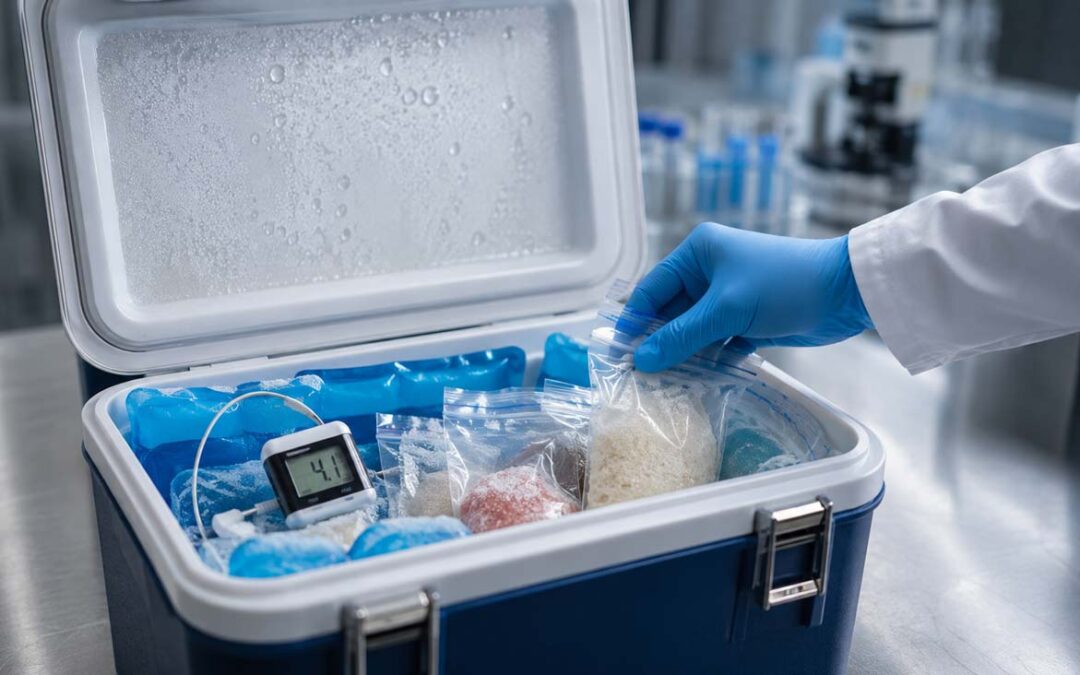
Your food safety results are only as good as your cold chain. Between your facility and our laboratory, temperature fluctuations can trigger bacterial growth or die-off, turning a compliant sample into a failed test. At SMT Labs, cold chain integrity is step one of accurate microbiology testing. Learn how temperature control makes or breaks your results.
Importance of Maintaining the Cold Chain
Maintaining the cold chain is critical in microbiology food testing laboratories to ensure the integrity, quality, and reliability of test samples (World Health Organization 2019). Failure to maintain the required temperature conditions during collection, transportation, storage, or handling may compromise sample stability, affect microbial growth patterns, and lead to inaccurate or unreliable test results (Adams and Moss, 2008). Choosing the best storage temperature for a given sample often depends on the nature of the sample, the intended use of the sample, and the length of time (International Organization for Standardization, 2017).
Food samples requiring refrigeration or freezing must be kept under controlled temperature conditions from the time of collection until laboratory analysis is completed (Forsythe, 2020). Proper cold chain management is especially important for preserving the microbiological quality of perishable food products and ensuring compliance with food safety and testing standards (Codex Alimentarius Commission, 2020).
What Is the Cold Chain?
The cold chain refers to maintaining samples within the required temperature range throughout (International Organization for Standardization, 2017):
- Collection
- Transportation
- Receipt at the laboratory
- Storage
- Testing
Typical storage conditions may include (South African Bureau of Standards,2019):
- Refrigerated samples: 2–8 °C
- Frozen samples: Below -20 °C
- Ambient samples: Controlled room temperature where applicable
Failure to maintain these conditions may result in sample degradation, microbial growth, or changes in product composition (Adam and Moss, 2008; Forsythe, 2020).
Best Practices for Maintaining the Cold Chain
Use Appropriate Packaging
Insulated containers with ice packs, gel packs, or dry ice should be used to maintain temperature during transit (World Health Organization, 2019). Packaging must be validated to ensure it maintains the required temperature for the duration of transport (Codex Alimentarius Commission, 2020).
Packaging should protect samples from temperature fluctuations and physical damage (World Health Organization, 2019).
Monitor Temperature
Temperature monitoring devices or data loggers should be used where necessary to verify that storage conditions were maintained during transportation (International Organization for Standardization, 2017). Continuous monitoring provides documented evidence of cold chain compliance and allows for corrective action if deviation occur (Forsythe, 2020)
Minimise Transportation Delays
Samples should be transported to the laboratory as soon as possible after collection to reduce the risk of deterioration (Adams and Moss, 2008). Delays in transit increase the risk of microbial proliferation or decline, which can invalidate test results (Codex Alimentarius Commission, 2020).
Immediate Storage Upon Receipt
Upon arrival at the laboratory, samples must immediately be placed into the correct storage conditions according to the sample requirements and test method specifications (International Organization for Standardization, 2017). Prompt storage limits exposure to ambient conditions and preserves sample integrity (South African Bureau of Standards, 2019).
Prevent Cross-Contamination
Appropriate segregation of raw and processed samples, along with sanitised storage areas, is essential to prevent cross-contamination (Codex Alimentarius Commission, 2020; Forsythe, 2020).
Ensure Your Samples Arrive Test-Ready
A broken cold chain means wasted time, failed audits, and unreliable data. Accurate results start long before your samples reach our bench. An unbroken cold chain ensures we test what was in your product, not what grew in transit.
REFERENCES
- Adams, M.R. and Moss, M.O., 2008. Food Microbiology. 3rd ed. Cambridge: Royal Society of Chemistry.
- Codex Alimentarius Commission, 2020. General Principles of Food Hygiene: CXC 1-1969. Rome: FAO/WHO.
- Forsythe, S.J., 2020. The Microbiology of Safe Food. 3rd ed. Chichester: Wiley-Blackwell.
- International Organization for Standardization, 2017. ISO 7218:2007/Amd 1:2013 Microbiology of food and animal feeding stuffs — General requirements and guidance for microbiological examinations. Geneva: ISO.
- South African Bureau of Standards, 2019. SANS 2859-1:2019 Sampling procedures for inspection by attributes. Pretoria: SABS.
- World Health Organization, 2019. Temperature-sensitive health products in the WHO supply chain. Geneva: WHO.